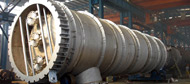
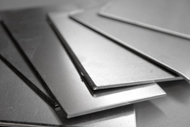
This specification covers chromium-molybdenum alloy steel plates for welded boilers and pressure vessels designed for elevated temperature service. Materials considered under this specification are available in grades 2, 12, 11, 22, 22L, 5, 9 and 91. The steel materials shall be killed and shall be thermally treated. The steel specimens shall undergo heat analysis and product analysis and shall conform to the chemical requirements for carbon, manganese, phosphorus, sulfur, silicon, chromium, molybdenum, nickel, vanadium, columbium, boron, nitrogen, aluminum, titanium, and zirconium. The steel specimens shall also undergo tension tests and shall conform to the required values of tensile strength, yield strength, and elongation.
This specification covers molybdenum alloy steel plates, intended particularly for welded boilers and other pressure vessels. Plates under this specification are available in three grades having different strength levels: Grade A; Grade B; and Grade C. The steel shall be killed. The steel shall conform to the chemical requirements specified. Tension tests on plates shall conform to the requirements specified. Plates under this specification are available in three grades having different strength levels as follows:
This specification covers carbon steel plates intended primarily for service in welded pressure vessels where improved notch toughness is important. According to different strength levels, the plates are available in four grades: Grades 55, 60, 65, and 70. The maximum thickness of plates is limited only by the capacity of the composition to meet the specified mechanical property requirements. The steel shall be killed and shall conform to fine austenitic grain size requirements. The mechanical properties such as tensile strength, yield strength, and elongation shall be determined by a tension test for the plates. A 515/A 515M Pressure Vessel Plates, Carbon Steel, for Intermediate- and Higher-Temperature Service A 516/A 516M Pressure Vessel Plates, Carbon Steel, for Moderate-and Lower-Temperature Service
Hot Rolled Medium & Low Tensile Structural Steel Width : 1250/ 1500 / 2000 / 250
ASTM A36,
IS 2062 GRADE A,
IS 2062 GRADE B, SS400,
S235JR, S275JR
This specification covers carbon structural steel shapes, plates, and bars of structural quality for use in riveted, bolted, or welded construction of bridges and buildings, and for general structural purposes. Heat analysis shall be used to determine the required chemical composition for carbon, manganese, phosphorus, sulfur, silicon, and copper. Tensile strength, yield strength, and elongation shall be evaluated using tension test and must conform to the required tensile properties.
This specification covers high-strength, low-alloy structural steel shapes, plates, and bars for welded, riveted, or bolted construction with atmospheric corrosion resistance. Heat analysis shall be performed wherein the low-alloy structural steel materials shall conform to the required chemical composition for carbon, manganese, phosphorous, sulfur, silicon, nickel, chromium, molybdenum, copper, vanadium, and columbium. Steel samples shall also undergo the tensile test and conform to required values of tensile strength, yield point, and elongation.
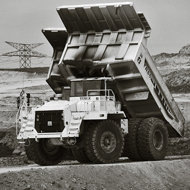
WEAR RESITANT STEEL PATES is used in areas where there is likely to be a high degree of abrasion or wear of the steel plate. Steels with a high HB rating (Brinel Hardness) are intended for applications where wear or abrasion resistance is important. The benefit of using an abrasion resistant steel is that that the plant, machinery or constructions working life can be extended considerably. This can significantly improve the reliability, durability and safety of structures and equipment. It also helps to reduce the maintenance costs associated with wear and breakdown of plant. 400 HB steel is over 3 times harder than mild steel (120HB), but only a third as hard as stainless steel (1250HB). Abrasion & mechanical wear-resistant steel plates for quarries & construction machinery: gravel & stone conveying plants (routes, chutes, hoppers) & crushing plants. Shovels, diggers, graders, bulldozers, dumpers, dredging machines, crushers, grinders, screens, hoppers, mixers, moulds for concrete aggregates. Wear resistance plates for mining machinery. Extractors, unloaders, spiral chutes, crushers, grinders, screens, conveyors. Abrasion-resistant steel plates for Cement Plants & Refractory Product Plants: hoppers, crushers, chutes, cyclones, excavator buckets
200 bhn hardnes material of Indian standard from SAIL , JINDAL & TATA
A high strength structural steel supplied in quenched and tempered condition. The steel is designed to provide excellent welding and bending properties and it offers substantial possibilities for savings in material costs, processing and handing. Due to its high strength, it enables design of lighter, more durable and efficient products and structures.
Applications: - Machine building - Lifting and mobile equipment - Vehicles and transport equipment - Steel constructions - Framework structures
Nearly 3 times as strong as A36. Used as liners for construction equipment, mining machinery, chutes, wear plates, etc.
Stainless Steel, Duplex Steel, High Nickel Alloys & Titanium Plates
Stainless steel is used primarily when corrosion or oxidation is a problem. The function that they perform cannot be duplicated by other materials for their cost. Over 50 years ago, it was discovered that a minimum of 12% chromium would impart corrosion and oxidation resistance to steel. Hence the definition “Stainless Steels”, are those ferrous alloys that contain a minimum of 12% chromium for corrosion resistance. This development was the start of a family of alloys which has enabled the advancement and growth of chemical processing and power generating systems upon which our technological society is based. Subsequently several important sub-categories of stainless steels have been developed. The sub-categories are austenitic, martens tic, ferritic, duplex, precipitation hardening and super alloys.
Duplex /Super Duplex Steel Width : 1250/1500/2000
Duplex & Super Duplex
S32750,
S32760
SAF 2205,
SAF 2507
A category of stainless steel with high amounts of chromium and moderate nickel content. The duplex class is so named because it is a mixture of austenitic (chromium-nickel stainless class) and ferritic (plain chromium stainless category) structures. This combination was originated to offer more strength than either of those stainless steels. Duplex stainless steels provide high resistance to stress corrosion cracking (formation of cracks caused by a combination of corrosion and stress) and are suitable for heat exchangers, desalination plants, and marine applications
High Nickel Alloys Steel Plate
Width : 1250/1500
Trade Names and Owners of Nickel Alloys
HASTELLOY IS A REGISTERED TRADE NAME OF HAYNES INTL.
Grade:
Hastelloy C-276
Hastelloy B-2 Hastelloy B-3
INCOLOY, INCONEL, MONEL AND NIMONIC ARE REGISTERED TRADE NAMES OF THE INCO FAMILY OF COMPANIES.
Grade:
Inconel 600,
Inconel 800, Inconel 825
Monel 400 ,
Monel 500
Nimonic 75,
Nimonic 90,
INVAR IS A REGISTERED TRADEMARK OF IMPHY S.A.
Grade: INVAR 36
An alloy whose main constituent is nickel Nickel alloys are used extensively because of their corrosion resistance, high temperature strength and their special magnetic and thermal expansion properties. The major alloy types that are used are:
Iron-Nickel-Chromium alloys / Stainless Steels
Copper-Nickel alloys and Nickel-Copper alloys
Nickel-Chromium and Nickel-Chromium-Iron alloys
Low Expansion Alloys / Magnetic Alloys
Commercially Pure Grade 2 titanium is the work horse of the commercially pure Ti grades. It is slightly stronger than Grade 1, but equally as corrosion resistant in a wide variety of environments.
Chemical Processing & Chlorate Manufacturing, Desalination, Architecture, Medical, Power Generation, Marine, Hydro Carbon Processing, Automotive, Aerospace



 Sheet & plate